Commercial Roofing FAQ for Enfield
Answers On Systems, Costs, Winter Weather, And Permits
Our commercial roofing FAQ for Enfield answers what building owners ask about TPO, EPDM, industrial, and metal roofs, replacement cost, winter weather, and permits.
Commercial Roofing FAQ for Enfield, By Topic
Each answer in this commercial roofing FAQ for Enfield building owners is grouped by topic. Pick one to jump to it, or call (959) 922-4217 with a question about your own roof.
Commercial Roofing in Enfield
- What counts as commercial roofing for an Enfield business property?
Commercial roofing covers the roof systems on business, industrial, and institutional buildings, mostly low-slope membranes such as TPO and EPDM, plus metal roofs on warehouses and shops.
The work includes installation, replacement, and repair on distribution warehouses, cold storage, offices, and retail buildings. It differs from house roofing in scale, materials, rooftop equipment, and the need to keep a business running during the job.
- TPO or EPDM: which membrane suits a commercial building in Enfield?
Both work on low-slope commercial roofs. TPO is a white, heat-welded membrane that reflects sunlight and forms welded seams. EPDM is a black rubber membrane with taped or adhered seams that stays flexible in cold weather. The choice depends on the deck, insulation, rooftop equipment, how the building is heated and cooled, and what is on the roof now.
- How long does a commercial roof last on a building in north-central Connecticut?
It varies with the system and conditions rather than following a fixed number of years.
Lifespan depends on the membrane or metal type, installation quality, drainage, how well flashings and seams are maintained, rooftop foot traffic, and how hard winters hit the roof with freeze-thaw cycles, snow, and ice. Regular inspections and prompt repair of small problems keep any system in service longer.
- What should Enfield facility managers look for when comparing commercial roofing companies nearby?
Look for a contractor who inspects the roof before quoting, explains the system and why it fits, and puts the scope in writing: tear-off or recover, insulation, flashing, and drainage details.
Ask about permits, insurance, and how the crew will keep the building operating. Confirm the contractor's Connecticut registration through the state's eLicense lookup, which Enfield's Building Inspection department points owners to.
TPO Roofing
- What is TPO roofing, and why is it used on Enfield commercial buildings?
TPO (thermoplastic polyolefin) is a single-ply roofing membrane, usually white, installed in wide sheets and joined with hot-air welded seams.
It is used on low-slope commercial roofs because the welded seams make the roof act as one sheet and the light surface reflects summer sun. It can be mechanically fastened or fully adhered over insulation, depending on the deck and wind exposure.
- What are the downsides of TPO roofing in a Connecticut climate?
TPO's weak spots are its seams and flashings, which depend on careful welding, and its surface, which dropped tools and foot traffic can puncture. White membranes show dirt and need cleaning to stay reflective.
In Connecticut, snow and ice add stress at drains and edges, so detailing there matters. None of these rule TPO out; they shape how it is installed and maintained.
- How are TPO seams welded on an Enfield warehouse roof?
We weld TPO seams with a hot-air welder that fuses the overlapping sheets into one piece. The crew sets the welder's temperature and speed for the day's weather, test-welds a sample, then probes every finished seam for gaps. Corners, curbs, and pipe penetrations get prefabricated or field-made flashings welded the same way, so the roof is joined membrane to membrane.
- Is TPO or EPDM the right roof for an Enfield cold storage building?
Both can work on cold storage, and the decision usually turns on insulation, condensation control, and rooftop refrigeration equipment more than the membrane alone.
TPO's white surface reflects summer sun, which limits heat gain at the roof. EPDM stays flexible in cold weather and takes simple seam repairs. We look at the deck, insulation thickness, and vapor control before recommending either.
EPDM Roofing
- What is EPDM roofing on a commercial building in Enfield?
EPDM (ethylene propylene diene monomer) is a synthetic rubber roofing membrane, usually black, laid in large sheets over insulation on low-slope roofs. Seams are joined with tape or adhesive, and the membrane is held down by adhesive, mechanical fasteners, or ballast stone. The rubber stays flexible in cold weather, which suits roofs that go through Connecticut winters.
- What are common problems with EPDM roofs on Enfield buildings?
Most EPDM trouble shows up at seams, flashings, and edges rather than in the open sheet. Seam tape or adhesive can lift with age, flashings around curbs and pipes can pull away, and shrinkage over time can stress the perimeter.
Punctures from foot traffic and snow shovels also happen. These are usually repairable; widespread seam failure or wet insulation points toward replacement.
- Fully adhered or ballasted EPDM: which fits an Enfield commercial roof?
Fully adhered EPDM is glued to the insulation or cover board, which keeps the sheet flat and makes leaks easier to trace.
Ballasted EPDM is loose-laid and held down by stone, which installs quickly but adds weight the structure must carry and hides the membrane. The choice depends on the deck's load capacity, wind exposure at the edges, and how often the roof is serviced.
- When does an Enfield building need an EPDM roof replacement instead of more repairs?
Replacement makes sense when seams are failing across the roof, the membrane has shrunk and pulled flashings loose in many places, or core cuts show wet insulation over large areas.
Patching a roof in that condition tends to chase leaks from one spot to the next. If the deck and most insulation are dry and sound, a recover over the existing roof may be an option where code allows.
Industrial Roofing
- What is industrial roofing for Enfield plants and distribution centers?
Industrial roofing is roofing for manufacturing plants, distribution centers, and other heavy-use buildings, where roofs are large and carry exhaust fans, ductwork, and other rooftop equipment. The systems are mostly TPO, EPDM, and metal, chosen for the roof's size, drainage, and conditions inside the building. The work is planned around production schedules, shipping docks, and safety around equipment.
- How do you roof around rooftop equipment on an Enfield industrial building?
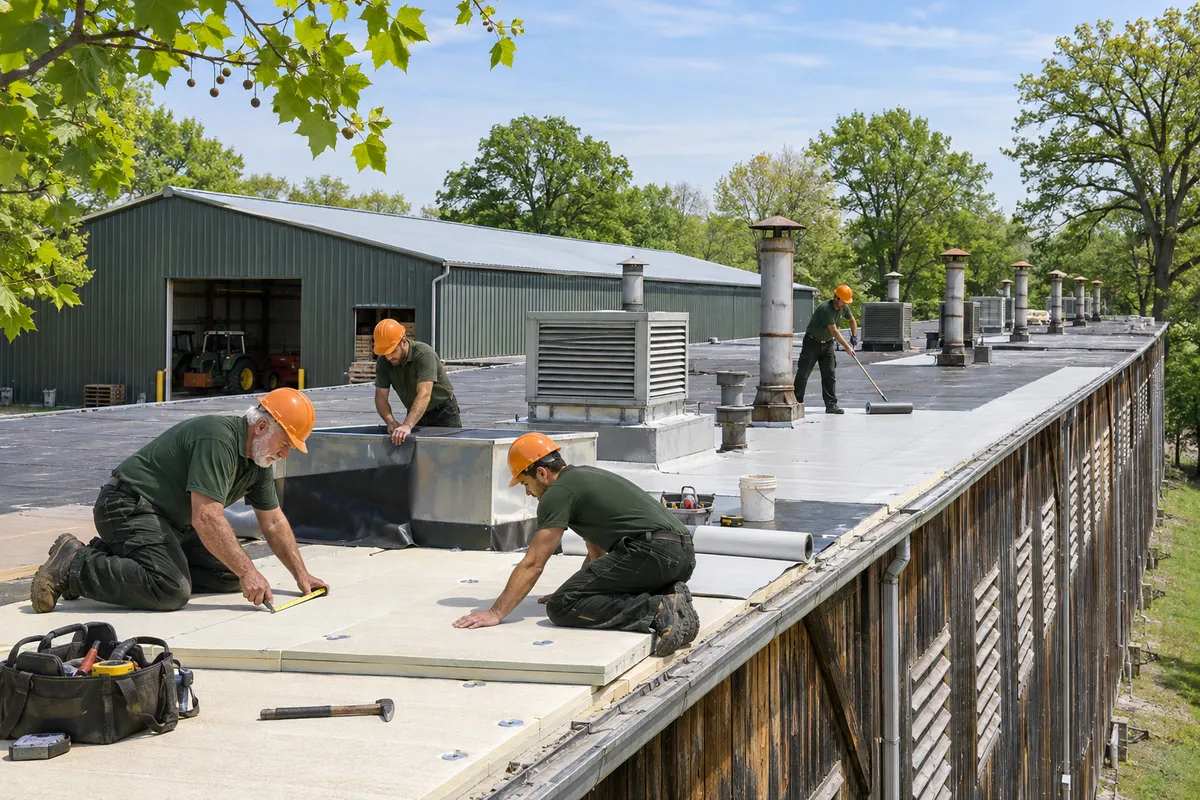
Every unit, curb, duct, and pipe that passes through the roof gets its own flashing tied into the new membrane. We coordinate with the building's mechanical contractor when units have to be lifted or disconnected, raise curbs where new insulation makes the roof thicker, and add walkway pads on service routes so technicians do not wear through the membrane.
- What does an industrial roof replacement involve near Enfield?
It starts with core cuts to check the deck and insulation, then a plan for tear-off or recover, staging, and protecting operations below.
The crew removes old roofing in sections, repairs the deck, installs new insulation and membrane, flashes equipment and walls, and closes each section watertight by the end of the day. Phasing lets production and shipping continue during the replacement.
- How should an Enfield manufacturer compare industrial roofing contractors?
Ask each contractor how they will handle core cuts, deck repairs, equipment flashing, and daily tie-ins, and get that scope in writing. Ask how they work safely around rooftop equipment and active production, and how staging, cranes, and dumpsters fit your site. Then compare the written scopes line by line, since two bids can cover very different work.
Question About Your Own Roof?
Leaking Now
Call and describe where water shows inside, and we can talk it through on the phone.
Commercial Metal Roofing
- Standing seam or exposed fastener metal: which roof fits an Enfield commercial building?
Standing seam panels join at raised seams with concealed clips, so no fasteners go through the panel face and the panels can move with temperature changes.
Exposed fastener panels are screwed through the face, cost less to install, and suit simpler buildings, but their fasteners and washers need maintenance over time. Roof slope, building use, and budget usually settle the choice.
- Is commercial metal roofing a good fit for Enfield tobacco sheds and agricultural buildings?
Yes, metal roofing is a common choice for agricultural and storage buildings because it sheds snow and rain on sloped roofs and installs over open framing. We install new panels, replace damaged ones, and maintain fasteners and trim on existing metal roofs. Ventilation and condensation control matter in sheds and barns, so we check them before choosing panels and underlayment.
- Can a metal roof go over an existing roof on an Enfield building?
Often, yes. A metal roof can be installed over an existing roof on a framing or purlin system, as long as the structure can carry the added load and the existing layers fall within code limits on recovering.
We check the deck, the number of existing layers, and moisture in the old roof first, because trapping a wet roof under new metal causes problems later.
- What drives commercial metal roofing cost per square foot in Enfield?
Price per square foot depends on the panel type and gauge, roof size and slope, tear-off versus installing over the existing roof, framing or deck repairs, insulation, trim and flashing details, and access for lifts and staging.
Snow guards, gutters, and penetrations add to it. We price each roof after measuring it and checking the structure, so the number reflects that building.
Replacement, Cost, and Connecticut Weather
- What drives commercial roof replacement cost in Enfield?
The biggest factors are roof area, the system chosen, and how many existing layers must be torn off. Deck repairs, wet insulation found by core cuts, the number of curbs, drains, and wall flashings, and access for cranes and staging also move the price.
A roof crowded with rooftop equipment costs more per square foot than a clear, open roof of the same size.
- How do core cuts help plan a commercial roof replacement in Enfield?
Core cuts are small samples taken through the roof down to the deck. They show how many layers are on the roof, what insulation is there, whether it is wet, and the deck's condition.
That tells us whether a full tear-off is needed or a recover is possible, and how much insulation and deck work to plan for. Each cut is patched watertight right after sampling.
- How do snow and ice at parapets and drains affect commercial roofs in Enfield?
Snow and ice concentrate at parapet walls, roof drains, and scuppers, where meltwater refreezes and backs up. That ice holds water against flashings and seams far longer than rain alone would. We detail those areas with extra membrane and taller flashings where possible, keep drains clear, and set drain sumps so meltwater leaves the roof instead of pooling.
- Does freeze-thaw weather in north-central Connecticut change which commercial roof to install?
It shapes the details more than the system. Freeze-thaw cycles work water into loose seams, open flashings, and cracked edges, so seam quality, flashing heights, and drainage matter more than the membrane brand. Insulation and vapor control matter too, since warm indoor air leaking into a cold roof assembly can condense and freeze. We design the details around those conditions.
Permits and Building Operations
- Where do Enfield building owners apply for a commercial reroofing permit?
Enfield's Building Inspection department, now at 810 Enfield Street next to Town Hall, takes permit applications online only. Before applying, check the town's permit exemption list for commercial buildings. The town publishes separate instructions for commercial building plans, and projects beyond one- and two-family houses need three sets of plans when plans are required.
- How do you keep an Enfield cold storage or distribution building running during a reroof?
We phase the roof in sections, tear off only what can be closed watertight that day, and schedule noisy or dusty work around shipping and production.
Dock areas, sensitive storage, and rooftop equipment get planned separately, and protection goes over anything below an open section. For cold storage, we coordinate with refrigeration contractors so units come off and go back on in order.
Service Areas Around Enfield
- Do you install TPO and EPDM roofs on commercial buildings in Granby?
Yes. We install, replace, and repair TPO and EPDM roofs on commercial buildings in Granby, along with metal roofs on shops and storage buildings. Each project starts with a roof inspection and core cuts where needed. Permits for Granby buildings go through Granby's own building department, and we plan the work around how the building operates.
- Can you replace a warehouse roof in East Windsor without shutting down operations?
In most cases, yes. On East Windsor warehouses we replace roofs in sections, close each one watertight before the crew leaves, and plan tear-off, staging, and crane picks around dock traffic. Rooftop equipment and areas over sensitive inventory get their own sequence. Core cuts before the job show where deck or insulation repairs will be needed.
- Do you put metal roofs on commercial and agricultural buildings in Suffield?
Yes. We install and replace commercial metal roofs in Suffield, including standing seam on commercial buildings and exposed fastener panels on agricultural and storage buildings. Existing metal roofs get panel replacement, fastener and trim work, and maintenance. We check framing, ventilation, and condensation control before choosing panels.
- Is commercial roofing available for industrial buildings in Windsor Locks?
Yes. We install and replace TPO, EPDM, and metal roofs on industrial and commercial buildings in Windsor Locks. Roofs with heavy rooftop equipment get curb, duct, and pipe flashings tied into the new membrane, plus walkway pads on service paths. Work is planned around production, shipping, and safe access for the crew.
- Which other towns around Enfield does your commercial roofing work cover?
Along with Enfield, Granby, East Windsor, Suffield, and Windsor Locks, our commercial roofing work covers Thompsonville, Hazardville, Stafford Springs, Stafford, East Granby, Somers, Ellington, Broad Brook, Union, Willington, and Chaplin. If your building sits outside these towns, give us a call and we will tell you whether it is within reach.
Ask What Our Commercial Roofing FAQ for Enfield Leaves Out
Send the property address for a roof walk, or call with the question you still have.